Alcaraz & Sinner: the new rivalry in men’s tennis
Entire decades of men’s tennis are defined by epic rivalries. In the 1980s, there was the rivalry between Jimmy Connors and John McEnroe: both true competitors who showed a lot of emotion on the court. Then came the 1990s, the decade of Andre Agassi and Pete Sampras, two players whose personalities could not be more different. Sampras was reserved and methodical; Agassi was a showman.
In the mid-2000s, a new rivalry emerged, this time between two Europeans: the Swiss Roger Federer and the Spaniard Rafael Nadal. By the next decade, Novak Djokovic, from Serbia, had forced his way into what became an epic, three-way rivalry.
Federer retired in 2022; Nadal followed two years later. Djokovic has remained competitive, playing respectably in recent years. He holds the record for 24 Grand Slam tournament titles—edging out Nadal’s 22 and Federer’s 20. But the 38-year-old said recently that it would be “very difficult” for him to win another Grand Slam.
The reason is that men’s tennis is already in a new era. And it looks like two more Europeans will dominate the circuit for the foreseeable future.
They are Jannik Sinner and Carlos Alcaraz.
Sinner is tall and lean—1.91 meters. And he uses every centimeter of his long limbs to cover ground on the court. He doesn’t show a lot of emotion when he’s playing. He comes across as disciplined and methodical.
Alcaraz is strong and explosive; he moves quickly around the court. He has a deep arsenal of moves; he’ll improvise to win a point that looks impossible. He’s expressive and charismatic, often pounding his chest and screaming.
Jannik Sinner, from Italy, and Carlos Alcaraz, from Spain, have been playing each other since 2019. In fact, Alcaraz’s first professional tennis match was against Sinner: Alcaraz was fifteen years old; Sinner, two years older. In that match, Alcaraz beat his more established opponent in three sets. No one knew it at the time, but this was the beginning of a new era in men’s tennis.
Their first meeting in a major tournament came in 2022, in the early rounds at Wimbledon; Sinner won that battle. They met again in New York a few months later, where Alcaraz beat Sinner on his way to winning his first major title, the U.S. Open.
Sinner won his first major in Australia in 2024, then followed it up with a second win that year. Coming into this year, at the beginning 2025, Alcaraz had won three and Sinner two Grand Slam tournaments.
But this was the year that their rivalry really took shape. Tennis has four Grand Slam tournaments in a year. Jannik Sinner beat the German Alexander Zverev in the first tournament of the year, the Australian Open in January.
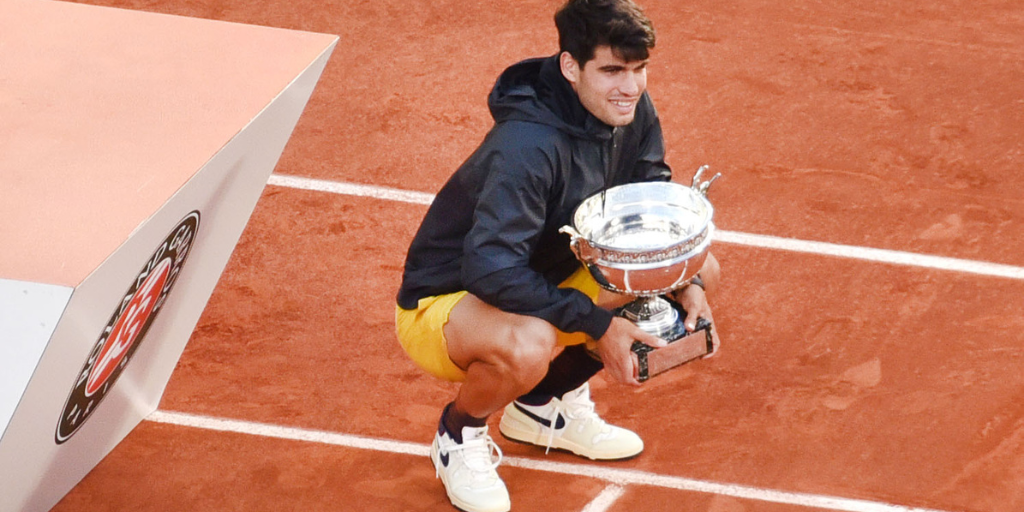
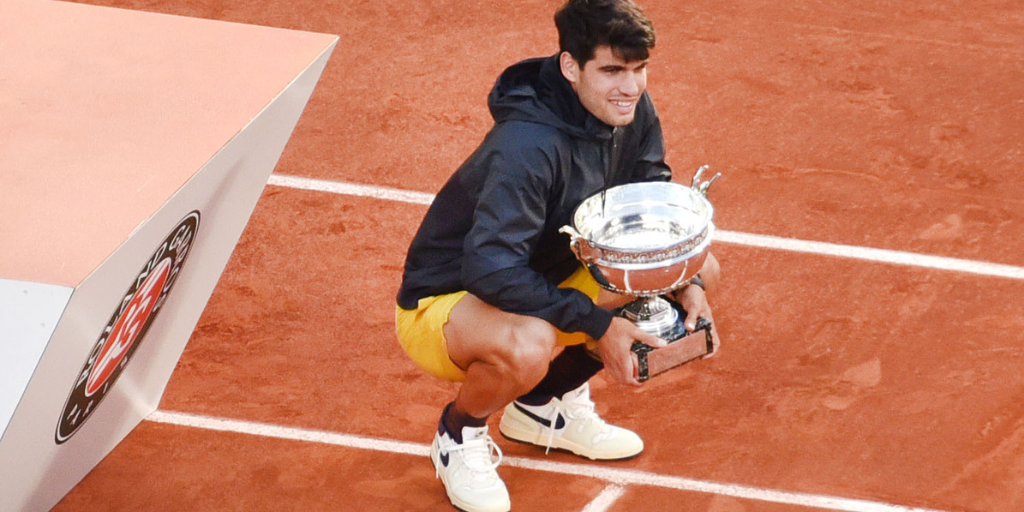
Then, Alcaraz and Sinner faced each other in the finals of the remaining three tournaments. Alcaraz won a thrilling, five-set victory in the French Open in May. It was an “instant classic.” Sinner was one point away from winning the whole tournament (twice), but Alcaraz pulled off an unexpected victory. It didn’t take long for Sinner to get his revenge, beating Alcaraz in the Wimbledon finals in July. And then Alcaraz beat Sinner in the U.S. Open final in September.
So, there were eight spots in the final matches of 2025’s four major tournaments. Sinner and Alcaraz claimed seven of them. Go back another year. In 2024, either Sinner or Alcaraz reached the finals of every major tournament—and between them, they won all four. No man not named Sinner or Alcaraz has won a Grand Slam tournament in two years.
After winning the U.S. Open this year, Alcaraz told Sinner, “I’m seeing you more than my family.” They even ran into each other twice in New York—at restaurants.
Is a dominant rivalry like this good for tennis? There are the two best players in the world—and then there’s a wide gap separating them from the next-best tier.
For casual fans who like an easy-to-follow storyline, a strong rivalry is good entertainment: it’s easy to remember two names and keep track of who has won what.
But the risk is that the first rounds of every major tournament can seem perfunctory—like the opening act for the finals that everyone knows is coming. I can imagine even casual fans saying, “What, Sinner and Alcaraz again?” in a year’s time.
Dedicated fans find this dynamic frustrating. There are a lot of good players in that second tier, players with different styles and skills, who may never get to shine because the game’s two giants dominate every final.
For maximum entertainment, it’s hard to beat the era that recently ended—an era dominated by three men, not two. Federer and Nadal had a longstanding rivalry—but then Djokovic stormed into the top tier. With three players at the top, there’s more drama and less predictability, but it’s still easy enough for casual fans to follow.
During that time, the British player Andy Murray was always a factor, occasionally reaching the finals—and very occasionally winning one—against the big three.
We are still in the early days of the Sinner-Alcaraz rivalry. An elite player can play in top shape for 12 years or more; Sinner and Alcaraz are about three or four years into their elite careers. Tennis players hit their peak performance between about ages 23 and 29. Carlos Alcaraz is just 22 years old; Jannik Sinner 24.
In other words, make sure to learn their names. If you’re even the most casual fan of sports, you’ll be hearing them a lot in the coming years.
Jeff’s take
They are fun to watch. I don’t watch a lot of tennis these days, but I did watch a few of the finals this year. The French Open final was thrilling; as good as it gets in sports. As a casual fan, I do like a good rivalry, but I also want others to break through, too. A sport shouldn’t be too predictable, you know?
Learn English the way it’s really spoken