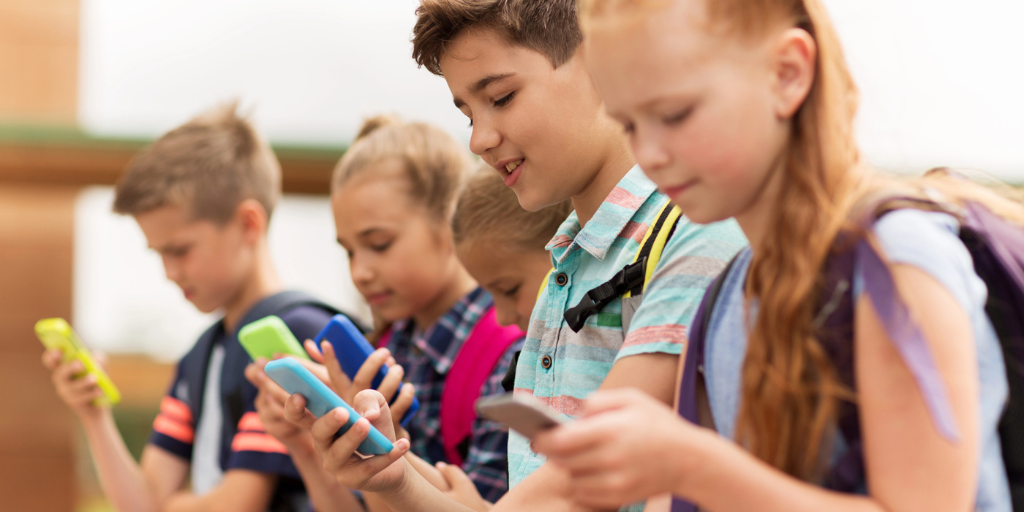
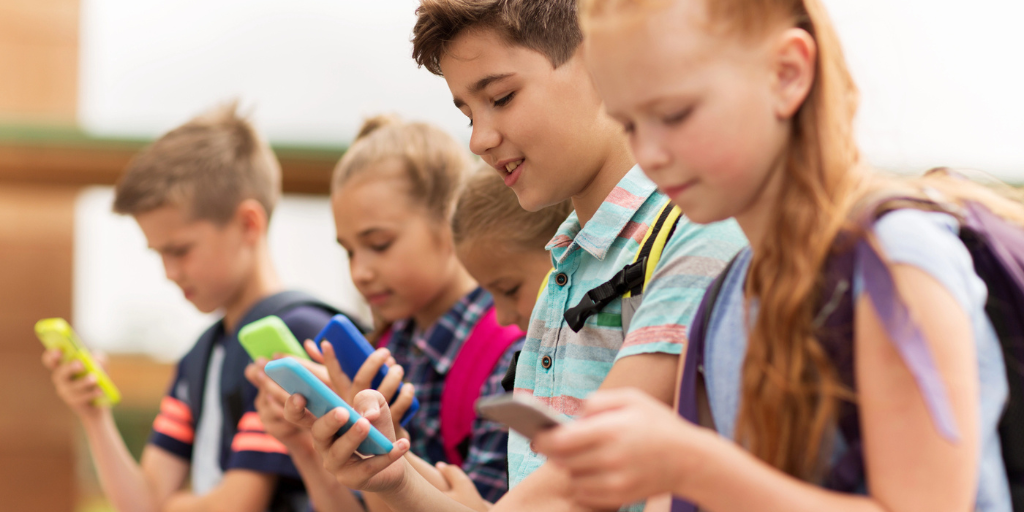
More schools are banning cell phones
School looks a little different in New York City this year. That’s because kids no longer have their phones with them during the school day.
New York state has joined a growing list of education systems that ban cell phone use during the school day. The ban in New York is “bell-to-bell.” That means that phones have to be locked up for the whole school day—for classroom time, and for free time like lunch, too.
Why do some people think phones in school are a bad idea? There are a lot of reasons for locking up phones, but I’ll give you three. First—and this won’t come as a surprise—they are a distraction. Kids get distracted by their phones, and they don’t pay attention, they don’t take notes, they don’t do the learning that they’re in school to do.
Second, phone time depletes kids’ cognitive ability. If they spend too much of their limited mental energy on their phones—even if it’s during breaks—then they have less brain power available for learning.
Phones can also amplify the interpersonal conflicts that are already so hard to deal with in school hallways. Bullying, gossip, and other conflicts find a wider audience on social media and messaging apps. When all that is happening during the school day, it’s yet another barrier to learning.
Some countries, states, and cities have banned cell phone use in the past, but just in the past two years, the movement has gained momentum, and the rules have been getting stricter.
France is a good case study. France introduced rules in 2018 that required middle-school students to turn off their phones during the day—but the kids were still allowed to hold onto them. Older students faced no restrictions. But now, French middle-schoolers will be required to check their phones at the door, after a successful pilot program earlier this year.
Brazil, New Zealand, and the Netherlands introduced phone bans in 2024. Sweden’s government has proposed a nationwide ban for kids age 7 to 16; if passed, it would take effect next year.
And two big U.S. states, New York and Texas, were among several that passed statewide cell phone bans that take effect this year, 2025. More than seven million students will have to check their devices at the door in just those two states. Now, a total of thirty-five of the fifty American states have some kind of statewide cell phone ban. Around the world, forty percent of national education systems have either implemented or proposed bans on phones.
Not everyone is pleased with the new rules. Many parents want to be able to contact their kids during the school day. A recent survey of a parents’ group said that the number one reason parents want their kids to have phones in school is safety. Many parents also like the convenience of using phones to arrange transportation to and from school, and to coordinate things like dentist appointments and after-school activities.
And while it makes intuitive sense that phone bans would improve learning, it hasn’t yet been proven on a large scale. The largest recent study looked at over 16,000 students in India. It found that students without access to phones did better academically, but the effect was small. Interestingly, phone bans helped lower-achieving students the most.
But most teachers don’t need a large-scale study to know that phones distract kids and interfere with learning. They say the cost of phones in schools—the cost to learning, the cost to mental health, the increase in bullying, the decrease in attention spans—the cost is just too high. In practice, classrooms without phones have less disruptive behavior and less cheating.
How are phone bans going? One teacher in the U.S. state of Alabama said he couldn’t believe the improvement. He recorded a popular TikTok video that showed his elation: “Today,” he said in the video, “all of my students…took notes in my class, did their assignment, asked for help when they got stuck, and turned it in, and then when they were done, they talked to each other.”
Other teachers say they feel relieved that they don’t have to deal with phone management during the day. Instead of telling kids to put their phones away, they can help them with assignments.
Even some of the kids acknowledge the benefits. Phone bans are almost universally unpopular at first. But many kids get used to it, and even appreciate the digital break. Remember the study of 16,000 students in India? After the ban was implemented, student support for cell phone bans increased by twenty per cent.
Jeff’s take
I couldn’t believe phones were ever allowed in school. That shows you how clueless I am about what it’s like to be a kid in the year 2025. I just assumed every school banned them—I couldn’t think of a single good reason for any kid to have a cell phone on in school.
I do understand the parents’ concerns about safety. Especially in the U.S., there are highly-publicized school shootings and emergencies. The idea that something would happen at school, and a parent wouldn’t know if their kids are okay—that’s frightening. And of course, parents communicate all day on their phones. Coordinating after school activities, pick ups, things like that, is harder if the kids are not available.
But I’m thinking of my school days. And I can tell you, we would never have been able to manage the temptation. Never. So, I am on the side of banning phones in school, from bell to bell.
Learn English the way it’s really spoken