New discoveries in ruins of Pompeii
The ancient Roman city of Pompeii has been studied for centuries. It’s one of the most famous ruins in the world, but only two-thirds of it have been explored. Now, part of that final third is being opened up for exploration—and archaeologists are finding new discoveries that show what life was like in this thriving Roman Empire city.
They uncovered things like a bathhouse, jewelry, and richly-painted rooms. They even learned about how some people tried to survive the famous volcanic eruption that destroyed the city.
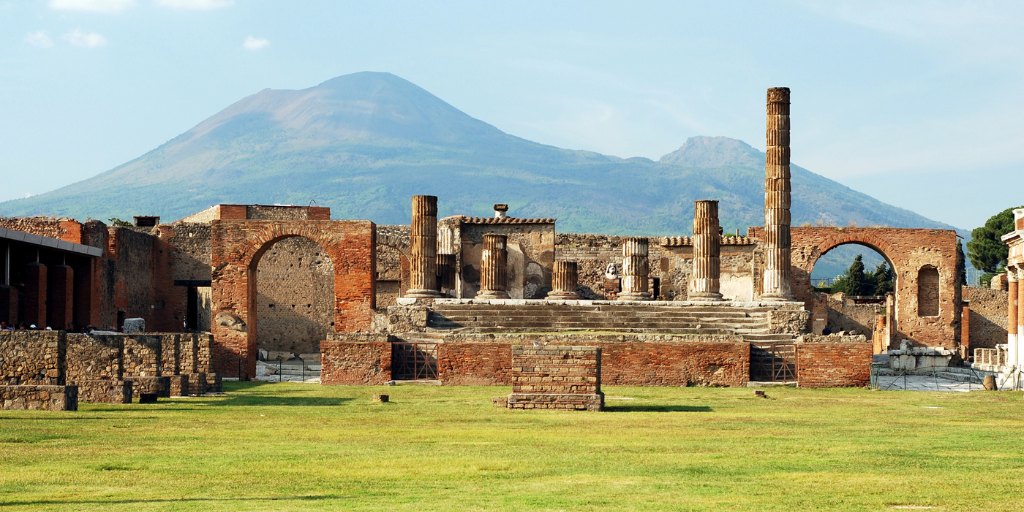
Pompeii was a city on the western coast of Italy, at the base of Mount Vesuvius, on the Bay of Naples. Humans first settled in the area in the 7th century B.C. By the first century A.D., Pompeii had become a lively town in the Roman Empire. Researchers estimate around 12,000 people lived in the city, including both the wealthy residents and their servants. It attracted visitors from far away.
Towering over Pompeii was the great Mount Vesuvius, a volcanic mountain nearly 1,300 meters high. But the residents at the time had no way of knowing it was a volcano: its most previous eruption would have been centuries earlier. But they were about to find out.
In the late summer or early fall of the year 79 A.D., Mt. Vesuvius erupted and buried the city under a thick layer of ash: the eruption lasted for at least a full day, maybe longer. In the first hours of the eruption, a lot of residents fled the area. But historians believe more than 16,000 people across the region lost their lives, including about 2,000 in Pompeii itself. It was one of the deadliest volcanic eruptions in all of history.
When it was all over, Pompeii was buried under as much as seven meters of ash and rock. That blanket of debris sealed off the city, preserving Roman life almost exactly as it was. After the disaster, the site was abandoned for more than a thousand years.
In the 1700s, explorers began to dig into the ruins of Pompeii and the surrounding towns. But they weren’t focused on preservation or learning. They were focused on loot: they took jewelry, artwork, and statues.
By the mid-1800s, attitudes had shifted. Italian archaeologist Giuseppe Fiorelli took charge of the site in 1860 and decided to share Pompeii with the world. He welcomed tourists for the first time and reported his findings to scholars.
Over the years, more and more of Pompeii was uncovered. Archaeologists found an amphitheater, temples, and luxury homes decorated with mosaics and art. But they also found small shops and cramped housing for workers.
Together, these discoveries turned Pompeii into something more than a collection of ruins. People began to see it as an open-air museum, a place where Roman life was frozen just before disaster struck.
Today, about two-thirds of Pompeii has been uncovered. The remaining third still lies underground, sealed beneath ash and rock.
But now, that final third is starting to be explored.
In 2023, archaeologists began a new excavation. It was the largest at Pompeii in more than 70 years. And they are starting to publish their findings.
The most striking discovery was a large bathhouse. It was located in a private home, a luxurious villa—and this was at a time when most homes didn’t have any baths. But this bathhouse would rival a modern-day spa. It had hot, warm, and cold baths.
It was decorated with brightly painted walls and detailed mosaics. It was big enough for thirty people. And it was connected to an elegant dining room. That same house also had a private laundry and a bakery. It probably belonged to an elite politician.
Another discovery showed the human toll of the volcano. In a small but well-appointed home, they found evidence that a family had tried to barricade themselves into a bedroom by pushing a bed up against the door. When they knew that wouldn’t save them from the eruption, they tried to flee the house—but they only made it as far as the dining room.
Archaeologists also found something that most of us can relate to, even today: a bench carved with rudimentary graffiti. They believe that servants, laborers, and other residents of the town would have waited on this bench to see the powerful people in a luxury villa. To pass the time, the people waiting carved their names, dates, and other small inscriptions into the bench.
The current excavation work is not happening on the entire remaining part of Pompeii, just on a small neighborhood. Excavation work moves slowly: it’s detailed, careful, painstaking work. So Pompeii may be providing more and more surprises well into the future.
When the current work is complete, the site may be open to visitors. About four million people visit Pompeii every year.
Jeff’s take
I was fascinated to learn how they “find” skeletons and objects like furniture. In many cases, they don’t find the objects at all. They just find a hole in the ash, where organic matter like bodies or wood furniture used to be.
And when they find the hole, they fill the hole with plaster. They carve out the surrounding rock, and the plaster that remains is a mold of what had been buried under the ash.
Learn English the way it’s really spoken