Sagrada Familia inches closer to completion
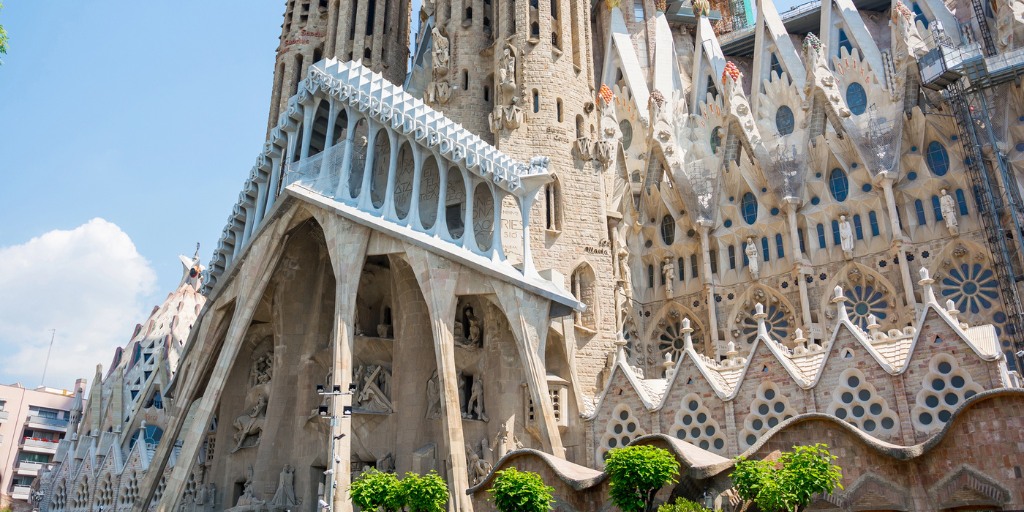
The Sagrada Familia is a cathedral in Barcelona, in the northeast of Spain. Its design is unlike anything else in the world. More than a dozen towers feature carvings and colorful details inspired by nature. Instead of the rigid walls and sharp edges of a Gothic cathedral, it has soft, natural shapes that look like they’ve grown from the earth. Inside, large columns resemble trees with branches at the top.
You can attend Catholic mass throughout the week, take a guided tour, and even see light shows on one of its façades. It was designed—mostly—by the Catalan architect Antoni Gaudí. His designs are unique, feature a blend of styles, and are inspired by nature. The Sagrada Familia is his most famous work. It’s one of Spain’s biggest tourist attractions, with about five million paying visitors each year.
But perhaps the most famous thing about the Sagrada Familia is that it’s unfinished: unfinished, even though construction began in 1882, unfinished even though its principal architect has been dead for ninety-nine years. Now, though, the end is…at least partially in sight, as the cathedral will reach an important milestone in the next few months.
But before we get to that, we have to ask the question: How is it possible for a construction project to drag on for over 140 years?
The Sagrada Familia is a one-of-a-kind project. Gaudí envisioned it as a living work of art, something that would take generations to complete. Even though he took over the project at age 31, he knew from the start that he wouldn’t live to see the final product.
Even after construction began, there were no detailed drawings and blueprints for the full structure. Instead, Gaudí created a vision with physical models, sketches, and broad principles. His vision included complex geometric shapes that weren’t even possible to construct during his time.
Gaudí relied on his faith that future generations would figure out new construction methods or revise his concepts later. And that is what has happened. Although many of Gaudí’s original models were destroyed during the Spanish Civil War, generations of architects have carried his vision forward. They rely on Gaudí’s vision, his style, and the models and drawings that survive. Technology has improved, and new techniques make many of his original ideas possible.
Religious services have been held at the Sagrada Familia almost since its construction began in the 1880s. But the interior basilica opened for religious services only in 2010. Since then, more towers have risen, new façades have been created, and digital design tools have allowed architects to move more quickly toward completion.
Soon, the Sagrada Familia will reach an important milestone: its central tower will be complete—the Tower of Jesus Christ is the largest of the eighteen total towers, and will be topped with a large cross, 17 meters tall. The Sagrada Familia will be the tallest Christian church in the world and the tallest building of any kind in Barcelona.
Not only that, but the cathedral’s leadership is growing more confident about a timeline for completion. By next year, 2026, the one hundredth anniversary of Gaudí’s death, the cathedral is expected to be structurally complete. Decorative details and a controversial staircase could take another twelve years.
Twelve years for a staircase? As with everything at the Sagrada Familia, it’s not as simple as it sounds. Gaudí envisioned the approach to the Sagrada Familia would come from the south, through a wide staircase that would rise toward the main façade. That face of the building, called the Glory Façade, would depict the history of humanity from Adam and Eve through the Last Judgment.
The problem is, the space is now filled with homes and shops, and building the staircase would mean tearing down part of the neighborhood. About 200 families would be displaced if the Sagrada Familia were to take all the land needed for Gaudí’s original vision. Getting the required planning permission, rehousing the families, demolition, and construction: they say twelve years, but timelines at the Sagrada Familia are prone to slipping.
There is no modern equivalent for a building taking this long to complete. The Cologne cathedral—also a majestic building—took 632 years. But that was started in the year 1248, back when construction was quite a bit more primitive. The Milan cathedral was started in 1386 and only finished in 1965. St. Peter’s Basilica in Vatican City was erected in lightning-fast time, just 120 years.
Gaudí himself wouldn’t mind. “The patron of this project is not in a hurry,” he once said (referring to God).
Jeff’s take
Planning is definitely not one of the strengths of the Sagrada Familia. When construction started, the area was rural—on the outskirts of Barcelona. Plans for the staircase were well known even then, but somehow they allowed homes to be built where the staircase was planned.
Here’s another detail. The construction was illegal for most of the basilica’s history. The city government discovered in 2016 that official permission had never been given for construction of the Sagrada Familia. So they issued a planning permit 137 years late, in 2019.
Great stories make learning English fun