Louvre robbers targeted French crown jewels
Last month, the Louvre was robbed. Hearing the news, you might have thought that thieves used high-tech tools to evade alarms late at night. You might imagine security guards turning on the lights in the morning, shocked to find an empty display case. But that’s not at all what happened. On a quiet Sunday morning, four thieves dressed as construction workers used basic tools to steal eight items from France’s collection of crown jewels—all while the museum was open and packed with visitors.
Here’s how it happened.
It was 9:30 a.m. on Sunday, October 19, 2025. The Louvre—the most-visited museum in the world—had already been open for thirty minutes. A group of thieves arrived on the narrow street between the museum and the River Seine, driving a specialized truck. It had a mechanized ladder mounted to the back. In Paris, these trucks are a common sight: they’re used to move bulky furniture into upper-floor apartments.
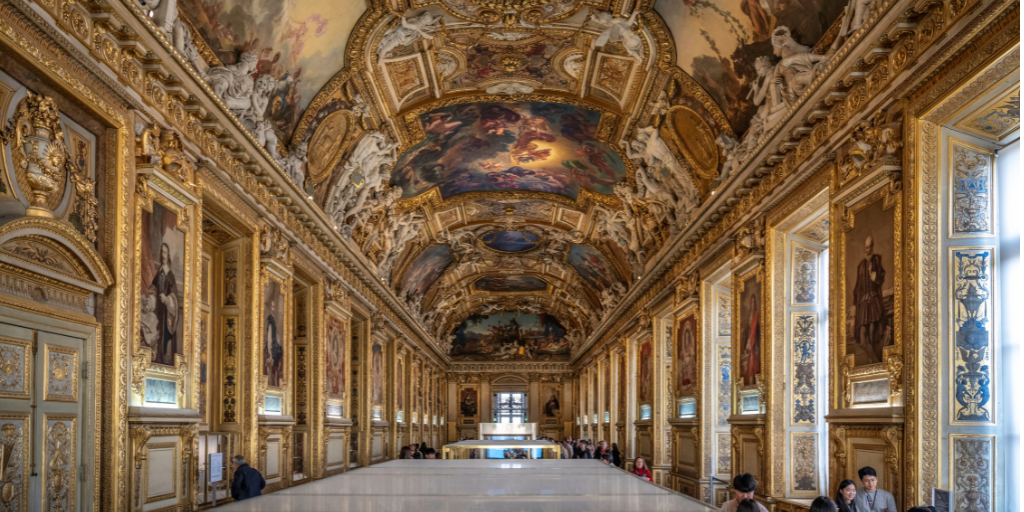
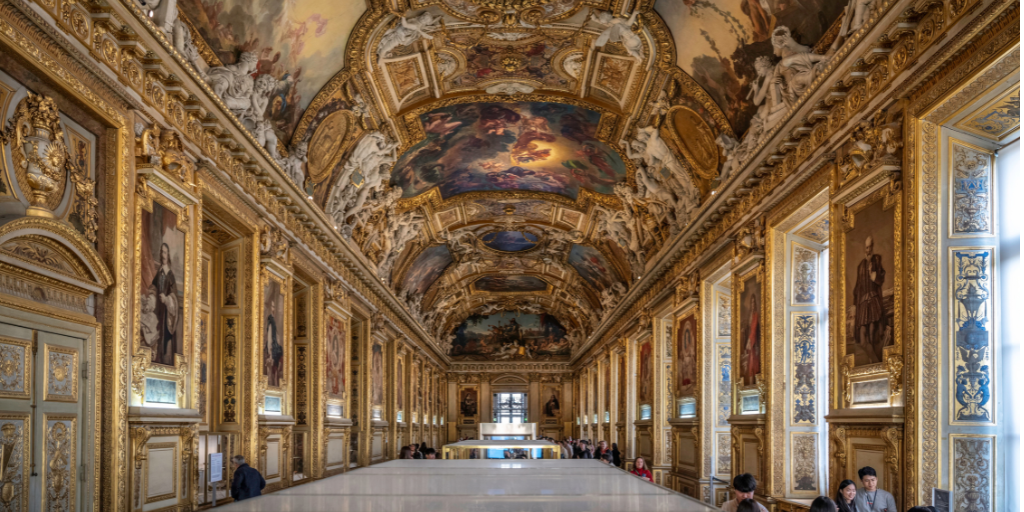
The group extended the ladder so that it reached a small stone balcony attached to the second floor of the museum. Two of the thieves scaled the ladder. They used power tools to break a window and enter the Apollo Gallery, setting off an alarm. The Apollo Gallery is a long, narrow room with display cases in the center. Inside those display cases are the most valuable jewels from France’s history as a monarchy and empire. The thieves smashed two display cases near the middle of the room, setting off additional alarms. They grabbed nine items of jewelry.
Then, they started their escape. They rushed back toward the broken window and descended the ladder. They tried to set fire to the truck, but were stopped by a security guard. They then met two accomplices waiting on motor scooters outside. They jumped onto the scooters and escaped. The whole thing took about seven minutes.
During their escape, they dropped one of the nine items they had grabbed—a diamond-encrusted crown. The crown was found damaged, but recoverable. But the thieves got away with eight pieces of priceless jewelry, touching different eras of French history.
One was a diamond and emerald necklace that Napoleon gave to his second wife upon their marriage. It has 32 emeralds and over 1,000 diamonds. The thieves also got the matching diamond and emerald earrings.
They stole a tiara, necklace, and set of earrings decorated with diamonds and sapphire. And they got away with a brooch, a decorative bow, and a tiara used by Empress Eugénie, the wife of France’s last emperor, Napoleon III. The tiara had 212 pearls and almost 3,000 diamonds.
What might happen to the stolen items? Jewelry experts say there are two likely scenarios. First, it’s possible that a wealthy individual wanted the jewels for his own personal collection. If that’s the case, the items will be hidden, but perhaps not lost forever. The other possibility—probably more likely—is that the jewels will be dismantled and sold for parts.
That would be a permanent loss. There are few likely buyers for the stolen jewels: it would be highly risky to sell or buy them whole, since they are well-known and connected with such a high-profile crime. But there’s a thriving international market for precious stones like emeralds, sapphires, and diamonds. So it’s likely that thieves will dismantle the jewels, recut the stones, and sell them one by one in the legitimate market, over time.
France has been shaken by the news of this heist. The Louvre, in particular, is important to France’s sense of national identity. The museum—both the building and its collection—connect France’s past as a monarchy to its present as a republic.
The Louvre’s founding idea—that the nation’s greatest art should belong to the people—that idea was revolutionary when the museum was established in 1793. Today, all the items in the museum are the property of the French state. The stolen objects were part of France’s crown jewels and were displayed in the Louvre’s most sumptuous gallery.
Emmanuel Macron, the president of France, said the heist was an attack on French history. The identity of the thieves is not known.
Jeff’s take
The Louvre has been robbed before; in fact, museum robberies are not as rare as you might think. Famously, the Mona Lisa was stolen in 1911. Twenty Van Gogh paintings were stolen from the Van Gogh Museum in Amsterdam in 1990, though they were later recovered. A Rembrandt and a Vermeer were stolen from a museum in Boston that same year. A curator of the British Museum snatched items from its warehouse and sold them on eBay. And, incredibly, a single thief—Stéphane Breitwieser—stole 239 pieces of art from museums all over Europe in the late 1990s and early 2000s. He kept the pieces in his house.
There will certainly be investigations into the security situation at the Louvre. Many are asking how it’s possible to park a truck right next to the building. Before the robbery, museum staff had been warning that the security team was overstretched. Now, it’s likely that the museum will have to devote more of its limited budget to safety and security.
Great stories make learning English fun