Fall on hard times
To “fall on hard times” means to experience a period of financial difficulty . This is a euphemism . This is a polite way of saying that a person or organization or a place has struggled economically . We usually use this in the past tense. And we can use it with a person, a business, or a community.
Let’s start with a person. What kind of economic difficulties might a person have? Well a job loss might cause a person to fall on hard times. A divorce , an injury , a medical condition , any of those things might cause a person to fall on hard times.
So you can say, “She fell on hard times after her divorce and she had to raise her kids by herself, all while trying to become a novelist .” Actually you can say that about J.K. Rowling. We know her now as a superstar author . But before she became famous for writing Harry Potter books, she fell on hard times. She experienced a period of financial difficulty; money was tight . She had a hard time making ends meet .
If someone loses a job and has to move into a smaller house or apartment, or take a much lower-paying job , if they have to change their lifestyle, if they struggle financially , can’t pay their bills —these are all times to use “fell on hard times.”
“He fell on hard times after he lost his job.” Like that.
You can say this about a business, too. If a business starts to lose money, has to lay off employees, or if there’s doubt about the business’s survival , we can say the business fell on hard times.
Department stores and catalogs used to be really popular in the United States—none more so than Sears. The biggest building in North America was named for Sears in Chicago. But in the 2000s, as shopping patterns changed, Sears fell on hard times. The company struggled for a long time, and now there are only a handful of Sears stores left in the U.S.
The company fell on hard times: revenue was down, profit was down, stores were closing , shoppers were going elsewhere . Sears fell on hard times.
And you can use this expression with towns and cities, too. The Midwest region of the U.S. used to be a booming manufacturing region . There were good jobs, thriving cities , a good future. The Midwest was a great place to live in the 1950s, 1960s, 1970s. You could make a lot of money, even without a college degree , and you could plan for a bright future . But then, when global trade expanded in the 1990s and 2000s, many cities in the Midwest fell on hard times.
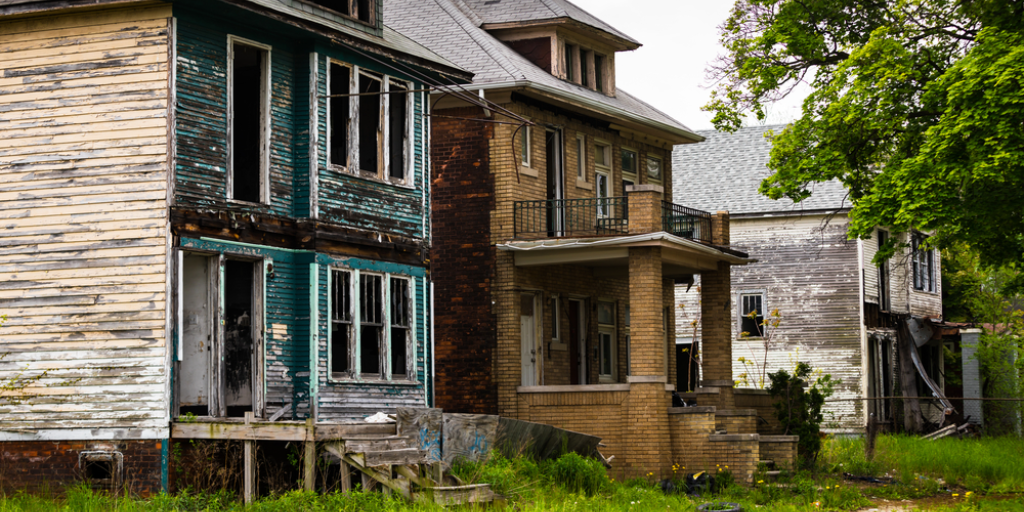
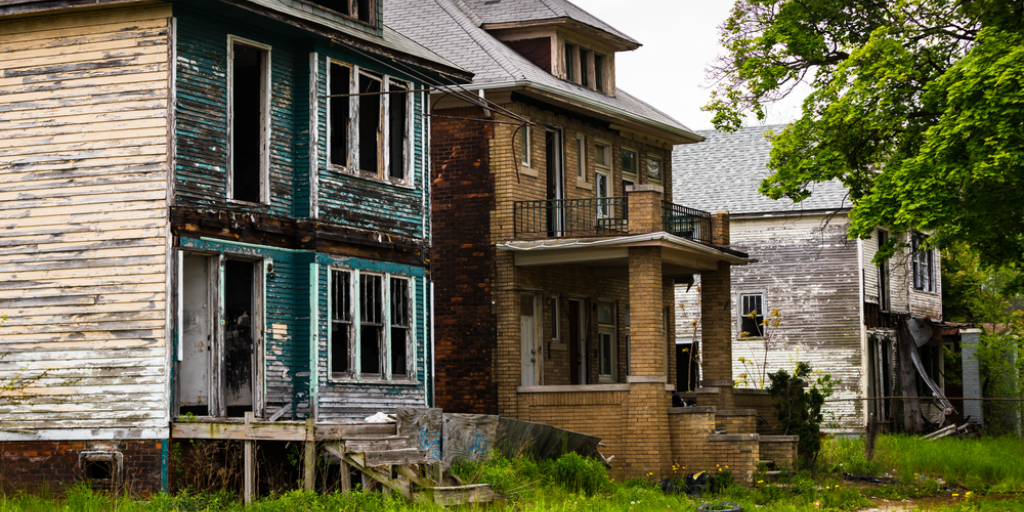
Detroit is a great example of this. Detroit fell on hard times. Manufacturing jobs left. Factories closed. Many of the services that supported factories also had to shut down. Unemployment was high. People moved away .
Detroit had 1.8 million residents in 1950 and 600,000 in 2020. Think about that. Think about what that can do to a place. The population of Detroit used to be three times bigger than it is now. The land area is the same. The roads and highways , schools, houses, streetlights —all the things that support a big population are all still there. And now there just aren’t a lot of people left.
The city fell on hard times. A small population without a lot of jobs had to maintain the infrastructure of a large city that was built for economic boom times. The city could barely keep the lights on , the water running , the buses running. The city still had to run snowplows over all its streets—but a lot of the streets were full of abandoned , empty houses.
Detroit was the biggest American city to declare bankruptcy . It had fallen on hard times. Detroit is improving ; it’s starting to come back. It’s not back to its glory days . It still faces a lot of problems . But the economy is diversifying ; downtown is getting better; and people say there’s life in Detroit. The football team even had its best season since 1991.
See you next time!
Now the Lions had fallen on hard times. That’s the football team in Detroit. They lost three quarters of their games between 2018 and 2021. Those were some long years for Lions fans. So the team had fallen on hard times, too. But it was good to see the Lions give Detroit something to celebrate last year.
All right, so that’s all for today’s Plain English. On Thursday, we’ll take a look at the South. You heard about all the people who moved away from the Midwest—well this is where they were going. You’ll learn about why the South is America’s most economically dynamic region these days. That’s coming up on Thursday. See you then.
Learn to express your best ideas
Get the tools you need to speak more fluently in English